

Seven cloth choices
Every current variant has the same 8-inch diameter, 3-inch center plate, 5/8-inch arbor hole, and listed price.

8-INCH AIRWAY BUFFING WHEELS
Seven cloth choices with a 3-inch center plate and 5/8-inch arbor hole for compatible buffing machines and polishing stages.
4.7 / 5 from 42 reviewsAvailable in stock
Couldn't load pickup availability
Available payment methods appear at checkout.
THE WHEEL AND COMPOUND WORK AS A SYSTEM
Airway wheels vary in treatment and stiffness. Use a firmer cutting setup to correct the surface, then change to a clean wheel and finer compound for color or final luster.
Every current variant has the same 8-inch diameter, 3-inch center plate, 5/8-inch arbor hole, and listed price.
The polishing contact occurs at the wheel edge; machine, arbor, guard, speed, and part control must all be compatible.
4.7 out of 5 from 42 reviews. Available review content appears below.
DECISION GUIDE
Match cloth construction and compound to the metal and polishing stage. Use a dedicated cutting wheel, then change to a clean wheel and finer compound for coloring or finishing.
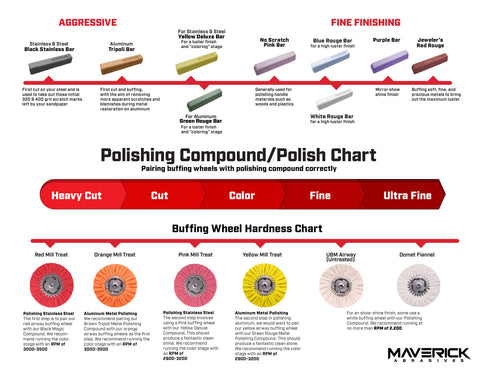
The current guidance pairs orange with brown Tripoli for an aluminum cut and red with Black Magic for an initial stainless-steel cut.
The current guidance positions yellow or pink wheels for coloring stages with a matched finer compound.
Untreated cloth choices with different constructions. Ask Maverick support when the required stiffness or compound pairing is uncertain.
A softer flannel choice for a fine finishing stage with a compatible compound and controlled heat.
ORIGINAL WHEEL GUIDE, RETAINED
The original Maverick video explains the treated, untreated, and flannel airway-wheel choices and how wheel stiffness changes across polishing stages.
ALL SEVEN LIVE WHEEL OPTIONS
All variants on this listing are 8-inch wheels with a 3-inch center plate and 5/8-inch arbor hole. The color or cloth label identifies the wheel choice—not a universal polishing sequence.
Established pairing: brown Tripoli compound for the initial aluminum cutting stage.
Established pairing: Black Magic compound for the initial stainless-steel cutting stage.
Established pairing: Green Rouge for the second aluminum color stage. The original copper-and-brass sequence also uses yellow with Yellow Deluxe.
The original guidance pairs pink with Yellow Deluxe for a stainless follow-up stage and with Purple for copper or brass.
Softer flannel option for fine finishing with a compatible blue or purple compound and controlled speed and heat.
Untreated cloth option. Ask Maverick to confirm stiffness and compound pairing for the specific material and finish.
Second untreated cloth construction. Ask Maverick when choosing between the two UBM options.
MATERIAL AND WHEEL-SIZE GUIDANCE
The original page positions the 8-inch size for detailed polishing while also explaining where larger airway wheels are commonly used.
The original guidance recommends considering an 8-inch wheel for detail work and tighter areas. This listing is only for the fixed 8-inch diameter, 3-inch center plate, and 5/8-inch arbor-hole configuration shown in the selector.
The original page describes 10-, 12-, and custom 14-inch wheels as formats generally used by professionals on large surfaces such as tanker work. It also notes that some shops choose 10-inch wheels for longer usable life and continue detail work as the wheel wears smaller. Only use a diameter, speed, flange, and guard configuration approved for the machine.
Choose the wheel cloth and compound as one system for the material and current polishing stage. Change to a clean wheel before introducing a different compound.
Plastics, wood, and composite materials appear in the original product guidance. Confirm wheel and compound compatibility, test an inconspicuous area, and control pressure and heat because these materials can respond differently from metal.
PAIRING ROUTINES
Use a clean orange wheel with brown Tripoli T-88 for the first cutting stage. Change to a clean yellow wheel with Green Rouge G-16 for the second color stage. A separate white flannel wheel with blue or purple compound can be used when an additional final finish is required.
For the stainless mini-kit sequence, pair a red wheel with Black Magic SS-11, followed by a separate clean pink wheel with Yellow Deluxe SS-617. A white flannel wheel with Blue Rouge SS-800 is an optional finishing choice. Follow the exact wheel label and machine instructions for speed and mounting.
Prepare and clean the surface before polishing; choose the preparation method for the actual tarnish, coating and finish target. Pair a yellow wheel with Yellow Deluxe, then use a separate clean pink wheel with Purple Rouge for the next stage. Test the sequence and follow the exact wheel and equipment speed limits.
The original page positions an 8-inch wheel for more detailed work, while 10-, 12-, and custom 14-inch wheels are generally used by experienced operators on larger flat surfaces.
EDGE BUFFING
Present the part so the wheel cannot catch an edge and throw it. Use secure part control, compatible guarding, and the machine manufacturer's operating procedure.
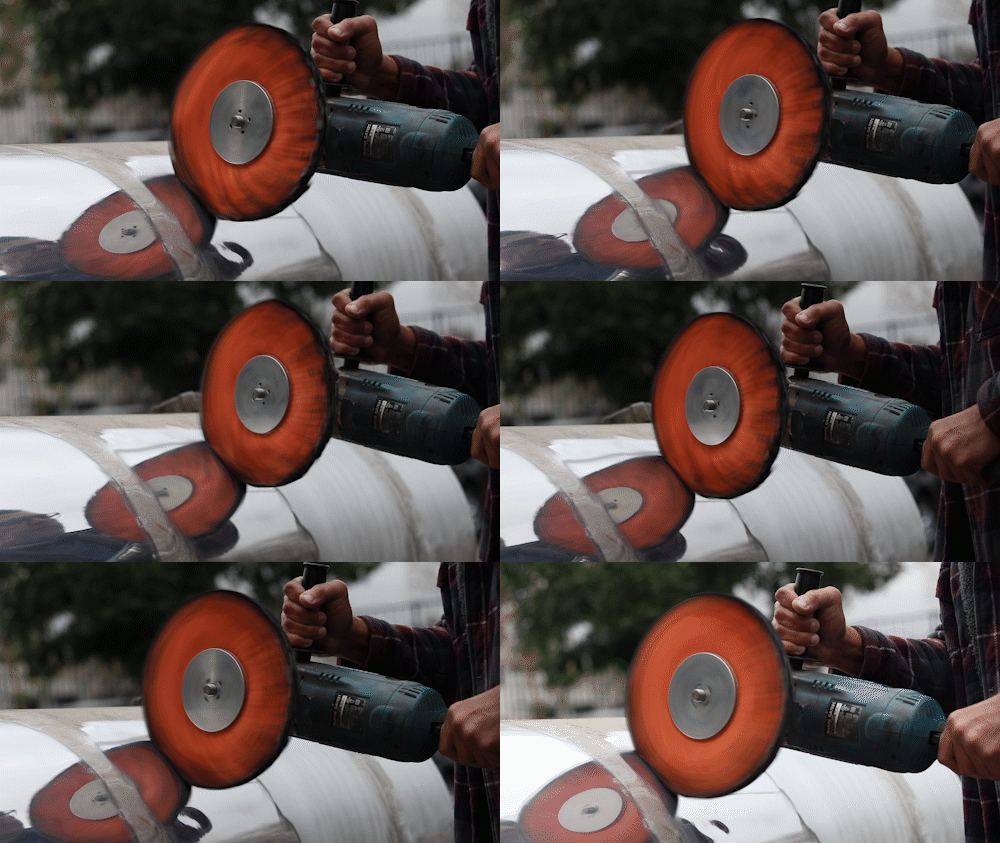
BUILD YOUR POLISHING SETUP
Match the fixed 8-inch diameter, 3-inch center plate and 5/8-inch arbor hole to an approved machine setup. Confirm wheel type, mounting hardware, flanges, clearance, guarding and the lowest applicable speed rating. A matching nominal arbor measurement alone does not establish compatibility.
Red and pink wheels with Black Magic and Yellow Deluxe bars, liquid polish, microfiber accessories, safety flanges and a rake.
THREE-WHEEL KITRed, pink and soft UBM wheels, black, green and purple bars, and safety flanges for a defined polishing sequence.
REPLACEMENT COMPOUNDSMatch the compound to the metal and polishing stage. Keep each formula on a dedicated wheel.
OTHER WHEEL SIZESReview each size and mounting configuration before selecting another diameter or pack.
Machine setup: A plain 5/8-inch arbor hole and a 5/8-11 threaded spindle are different mounting details. Use only the assembly, wheel type and speed approved by the wheel and machine manufacturers. Follow the required guarding, workholding and protection for the material and process.
HOW TO USE IT
Buffing wheels can grab edges and throw parts. Follow the machine manual, wheel guidance, and workplace safety procedures.
Confirm 8-inch wheel diameter, 3-inch center plate, 5/8-inch arbor hole, machine speed, arbor, flanges, and guarding.
Inspect the wheel before mounting; do not use a damaged, contaminated, or poorly centered wheel.
Mount and secure the wheel exactly as the machine manufacturer specifies, then test-run clear of the workpiece.
Apply the matched compound to a dedicated wheel and polish with controlled contact, movement, and heat.
Clean and inspect the surface before moving to a separate finer wheel-and-compound stage.
Use the guarding, extraction or collection, personal protective equipment, training, and operating procedures required by the machine, abrasive product, work material, and workplace.
PRODUCT FAQ
Every current option on this listing is an 8-inch wheel with a 3-inch center plate and 5/8-inch arbor hole.
The current Maverick guidance pairs the orange treated airway wheel with brown Tripoli compound for the initial aluminum cutting stage.
The stainless mini-kit sequence pairs a red wheel with Black Magic for cutting, followed by a clean pink wheel with Yellow Deluxe. The separate three-wheel steel kit has its own labeled black, green and purple compound bars. Follow the exact kit or formula sequence rather than treating wheel color as a universal guide.
Use a separate clean wheel for each compound. Coarse residue on a finishing wheel can reintroduce scratches.
Confirm the machine is approved for an 8-inch airway wheel with a 3-inch center plate and 5/8-inch arbor hole. Check the complete flange, guarding and speed requirements. A 5/8-inch plain hole does not by itself establish fit on a 5/8-11 threaded spindle or through an adapter.
Shipping methods, rates, and delivery estimates depend on the order and destination and are shown at checkout. Return eligibility, approval requirements, restocking fees, and return-shipping costs are explained in the return policy. Review the policy before ordering.
READY TO CHOOSE?
Confirm the fixed wheel dimensions, select the cloth type, and pair it with the correct polishing compound.
