
18" Airway Buffing Wheels For Polishing, 4 PACK
18" Airway Buffing Wheels For Polishing, 4 PACK
Available in stock (50000)
When the work is a tanker barrel, a large stainless vessel or long runs of sheet, an 18" airway buff covers more surface per pass than any smaller wheel and keeps a consistent finish across a big flat area. It mounts on heavy buffing lathes and backstands with a 1-1/4 Inch spindle, with a 5 Inch or 7 Inch center plate to match the machine's flanges. The pleated, ventilated construction matters more as diameter grows: air through the wheel keeps an 18" face from overheating on long passes and throws spent compound clear.
Sold as a 4-pack of one cloth type and. Buyers are usually shops that already run 14" or 16" wheels and add 18" for their largest flat work, or tank and trailer polishers who want fewer passes on aluminum.
- Wide 18" face for tanks, vessels and long flat panels; only the 20" covers more per pass
- 1-1/4 Inch arbor for heavy buffing lathes, backstands and industrial buffers
- 5 Inch or 7 Inch center plate: choose usable cloth depth or maximum plate support
- Four 18" wheels of one cloth type per pack, sized for shops that use 18" selectively
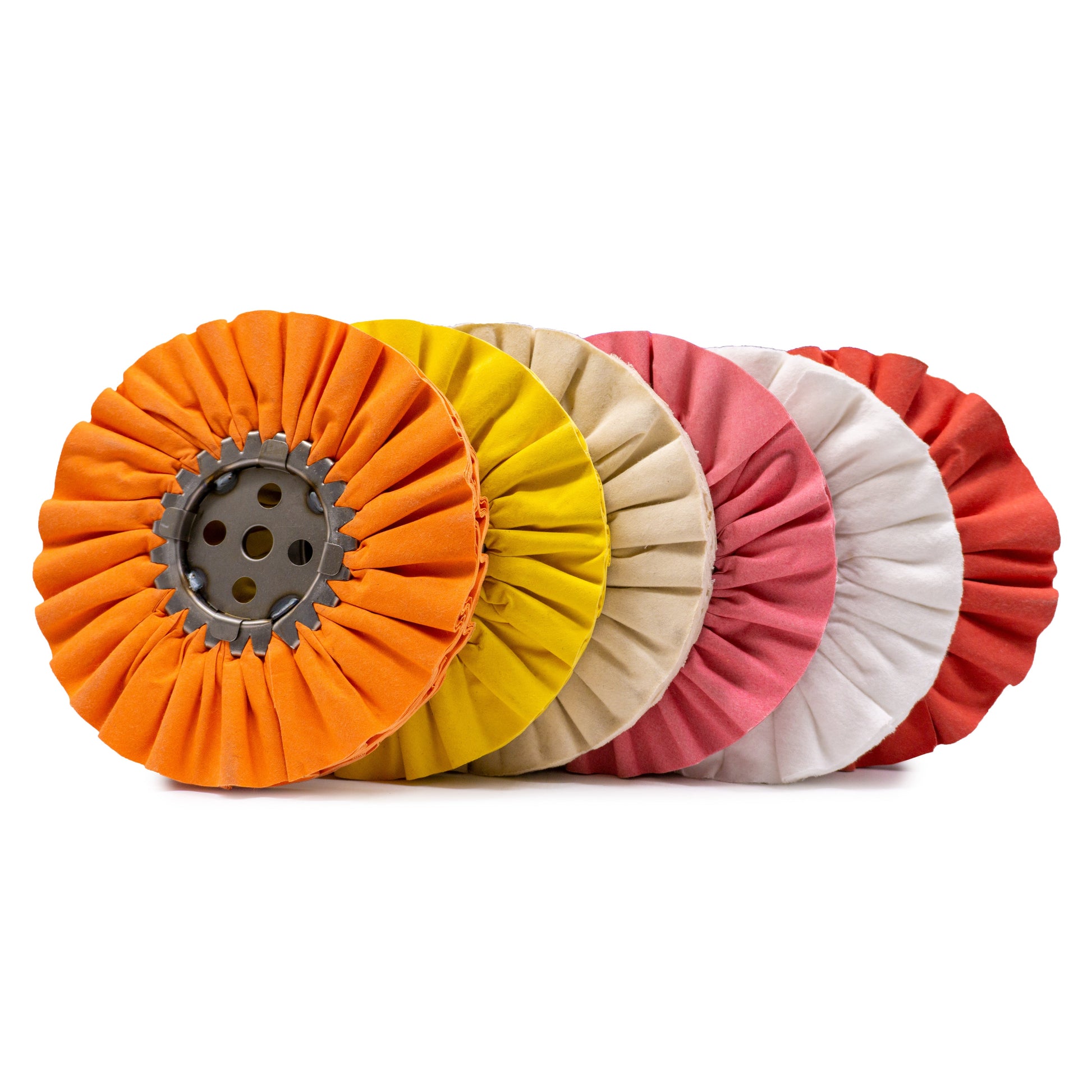
- Six cloth types: Red, Orange, Yellow treated; 86/80, Domet Flannel (White), Pink soft
- Free shipping on orders over $200
Which cloth type should you choose for an 18" wheel?
Large flat work rewards a firm cut wheel and a genuinely soft color wheel, because there is nowhere for a scratch to hide on a tank side. Pick one cloth type per pack and dedicate it to one compound.
- Red: treated, firm, our heaviest cutting buff. Stainless vessels and steel with the black stainless cutting bar.
- Orange: treated, medium-firm cutting wheel. Aluminum tank and trailer cut step with brown tripoli; the most common 18" order together with Yellow.
- Yellow: mill-treated cloth. Our color wheel on aluminum and stainless with green rouge, and the first step on brass and copper with yellow deluxe.
- 86/80: untreated, higher thread count cotton. Coloring and finishing with white or blue rouge; keeps its shape well on a wide face.
- Domet Flannel (White): the softest cloth. The final luster pass with the purple finishing bar for show tanks and polished trailers.
- Pink: soft finishing buff. Color step on stainless with yellow deluxe or green, on brass and copper with purple, and on plastics with no-scratch pink.
Which compound goes with which wheel?
| Metal | Cut (step 1) | Color (step 2) |
|---|---|---|
| Aluminum | Orange + brown tripoli | Yellow + green rouge |
| Stainless / steel | Red + black stainless bar | Pink + yellow deluxe or green |
| Brass / copper | Yellow + yellow deluxe | Pink + purple high luster |
| Show luster | after step 2 | Domet Flannel (White) + purple |
Sand brass and copper first: a scuff pad for light tarnish, 600 or 800 grit for heavy oxidation. An 18" wheel uses compound quickly, so most buyers pair these packs with the case pack of compound; single bars are available too. Keep one wheel per compound.
What machines run an 18" airway buff?
- Heavy industrial buffing lathes with 1-1/4" spindles and enough motor to keep an 18" wheel at speed under load.
- Backstand polishers set up for large sheet, tank shells and long extrusions.
- Two-spindle production buffers running an Orange cut wheel and a Yellow color wheel for aluminum.
Before ordering, check three things on the machine: the spindle is 1-1/4", the flanges and guard clear an 18" diameter with room for the part, and the spindle has enough thread to clamp flange, wheel and flange with the nut fully engaged. A machine that runs 14" wheels comfortably may not have the clearance or the motor for 18". 5 Inch or 7 Inch plate: the 5 Inch plate gives the most usable cloth and the longest life, and lets the wheel be run down and used as a smaller wheel; the 7 Inch plate holds more of the wheel rigid for heavy pressure on flat panels and matches machines with large flanges. Hand-held polishers and 5/8" bench buffers are not an option for this size; see the 10" airway buff for those.
How to get the most out of it
- Mount it true. Clean flange faces, plate seated, nut tight, then a hand spin to check clearance before power. An 18" wheel that is slightly off center shakes the whole machine.
- Dress it at speed with a buffing rake before the first part to open the pleats and true the face.
- Charge lightly. A short touch of the bar; a caked 18" face melts compound onto a tank side faster than you can wipe it off.
- Keep the part moving and traverse the whole face. Big flat work is where dwell marks and heat haze show most.
- Cut completely before color. Check the panel in raking light; anything left after the cut wheel will only get shinier under the color wheel.
- Wipe between steps and use Dissolver on the finished surface so no cut compound rides onto the Yellow, Pink or flannel wheel.
- Rake when glazed, rotate the four wheels so they wear together, and store spares flat and dry.
- Safety. Flanges both sides, guard fitted, face shield, gloves, respirator, no loose clothing, and run within the buff's rated speed for an 18" diameter.
The videos below explain the differences in mill treatment between the cloth colors and show wheel and compound pairing.
Use it for / don't use it for
Use it for
- Aluminum tanker barrels, fuel tanks, trailer sides and large castings on a lathe
- Stainless steel vessels, tanks and sheet on a backstand
- Long extrusions and architectural panels where fewer passes mean a more even finish
- Brass and copper production work after fine sanding
- Shops that keep 18" for large flat work and smaller wheels for shaped parts
Don't use it for
- Hand-held polishers, angle grinders or 5/8" bench buffers
- Machines without the clearance, spindle length or motor for an 18" wheel
- Small or shaped parts where a 10" to 14" wheel gives better control
- Removing weld beads or deep scratches; sand first, then buff
- More than one compound on a wheel
Specifications
| Diameter | 18 inch |
|---|---|
| Center plate size | 5 Inch or 7 Inch |
| Arbor hole | 1-1/4 Inch |
| Cloth types | Red, Orange, Yellow, 86/80, Domet Flannel (White), Pink |
| Construction | Pleated, ventilated cotton airway buff with steel clinch ring |
| Pack quantity | 4 wheels, one cloth type per pack |
| Typical machines | Heavy buffing lathes, backstands, two-spindle production buffers |
| Compound | Sold separately |
Frequently asked questions
When should I choose an 18" airway buff over a 16"?
Choose 18" when the work is large and flat, such as tanker barrels, tank shells and long panels, and your lathe has the clearance and motor to run it. The bigger face covers more surface per pass and gives a more even finish. For shaped parts and smaller machines, 14" or 16" is easier to control.
Will my buffing lathe run an 18" wheel?
It needs a 1-1/4 Inch spindle, guards and flanges that clear an 18" diameter with room for the part, enough spindle thread to clamp two flanges and the wheel with the nut fully engaged, and enough motor to hold speed under load. If the machine strains with a 16" wheel, stay at 16".
Which 18" wheels do aluminum tank polishers use?
Orange for the cut with brown tripoli, then Yellow for the color with green rouge. Both are treated wheels with enough body to work a large flat surface evenly. For a show finish, a Domet Flannel (White) wheel with the purple finishing bar follows the Yellow step.
Why is the 18" sold as a 4-pack when the 16" is a 10-pack?
Most shops use 18" wheels selectively for their largest work and run smaller wheels the rest of the time, so four wheels of one cloth type covers a cut or color spindle without over-stocking. Shops that run 18" all day can order case quantities by phone or email.
What is the difference between the 5 Inch and 7 Inch center plate on an 18" wheel?
Both use the 1-1/4 Inch arbor. The 5 Inch plate leaves the most cloth between the ring and the rim, so the wheel lasts longer and can be run down for use as a smaller wheel. The 7 Inch plate supports more of the wheel for heavy pressure on flat panels and matches lathes with large flanges.
How do I keep an 18" wheel from vibrating?
Mount it on clean flange faces with the plate seated square and the nut tight, spin it by hand to check it runs true, and dress the face at speed with a buffing rake before the first part. Rake again whenever the face glazes or starts to groove, and rotate the four wheels so they wear evenly.
Related products and guides
Couldn't load pickup availability
Your payment information is processed securely. We do not store credit card details nor have access to your credit card information.